

Sentence Structure
Kryptonian is a verb–subject–object (VSO) language. Verb-first order is a minority pattern among Earth’s languages, but some examples would be: the Goidelic languages (Irish, Scottish Gaelic, Manx), Classical Hebrew, Māori, and Tagalog.
English syntax is usually understood using a subject-predicate paradigm, where the predicate consists of the main verb phrase followed by whatever complements it — direct objects, indirect objects, obliques. Kryptonian instead splits along the premise/complement line: the premise holds the verb (including adverbs) followed by the subject, and the complement sits as a separate unit at the end of the sentence,
Kryptonian word order flows along the following rigid structure:
VERB (adverbial) SUBJECT ([particle] DIRECT OBJECT/EQUATIVE/OBLIQUE ([particle] INDIRECT OBJECT) (OBLIQUE))
Pro-Drop
Kryptonian is not subject-obligatory. Subjects can be dropped whenever they’re recoverable from context, but stay explicit whenever a sentence is complex enough to need disambiguating, or when a verb chain requires it.
Transitivity
Transitivity is completely unmarked grammatically — nothing about the verb’s shape or conjugation tells you whether it’s being used transitively or not. Transitivity is determined solely by the presence of a direct object (or even indirect object).
In most instances, the particle /w/ W is used to indicate the beginning of the complement, be it direct object, oblique, or equative. W isn’t a “direct object marker” but rather a boundary marker between the premise and the complement. Indirect objects are marked with the particle /ni/ I. Obliques do not carry particles, but can be recognized by their postpositions (more on that below).
Instrument / Agent
The Instrument particle, /ki/ K, marks the instrument, agent, or method of an action. In cases where the Instrument particle K appears directly next to the Complement particle W, it ecplises the complement particle and itself serves the function of marking the complement boundary.
We can see the semantic difference between the Complement particle and the Instrument particle in the translations of the following sentences.
Adverbs
Adverbials sit between the verb and the subject. Note: the distinction between adverbs and adjectives is a little blurry in Kryptonian, most adjectives can be used unmodified in the adverbial position to modify the action.
Joining Clauses
Conjunctions split cleanly into two classes by what they’re allowed to join (this kind of distinction isn’t entirely unique to Kryptonian). Intra-clausal conjunctions may only be used to join parts within a single clause, e.g., nouns, noun phrases, adjectives, verbs, etc. — never to join two complete clauses. Inter-clausal conjunctions do the reverse: they only ever join complete clauses, never smaller constituents.
When using one of these conjunctions, you always use the continuinating sentence punctuation mark: ; in front of the conjunction.
| Word | Logic | Mood |
|---|---|---|
| /zov/ zov | A and also B | Stative mood |
| /zuhne/ zUnE | A but B | Stative mood |
| /ze/ zE | A and then B | Stative mood |
| /zevah/ zEva | A causes B | Stative mood |
| /zovo/ zovo | A is caused by B | Stative mood |
| /izah/ iza | if A then B | Irrealis mood (requires subjunctive prefix) |
| /izo/ izo | A if B | Irrealis mood (requires subjunctive prefix) |
| /izehz/ izez | A unless B | Irrealis mood (requires subjunctive prefix) |
| /izha/ iZA | if A then not B | Irrealis mood (requires subjunctive prefix) |
PLACEHOLDER CONTENT FOLLOWS...
All of the content below is a mix of migrated material and AI-generated placeholder … which I have yet to go through and clean up.
Be aware that it may contain some (hopefully minor) inconsistencies or inaccuracies. Take extra caution relying on the translation examples.
Verbs
Verb Mood and Tense
Type-1 verbs mark tense and aspect with a single suffix, attached directly to the stem with no space — there’s a 3×3 grid of forms (see the Writing System page for the actual glyphs used for each cell):
| Progressive | Perfect | Simple | |
|---|---|---|---|
| Future | /i/ | /ao/ | /u/ |
| Present | /es/ | /ehth/ | /odh/ |
| Past | /as/ | /uhsh/ | /ahzh/ |
The full paradigm of a Type-1 verb, worked through with ewö /ehwor/ (“speak”):
| Progressive | Perfect | Simple | |
|---|---|---|---|
| Future | ewö! /ehwori/ — “will be speaking” | ewö@ /ehworao/ — “will have spoken” | ewö# /ehworu/ — “will speak” |
| Present | ewö$ /ehwores/ — “am/are speaking” | ewö% /ehworehth/ — “have spoken” | ewö^ /ehworodh/ — “speak” |
| Past | ewö& /ehworas/ — “was speaking” | ewö* /ehworuhsh/ — “had spoken” | ewö( /ehworahzh/ — “spoke” |
English doesn’t have a clean equivalent to the Kryptonian simple present. In English, an action actually happening right now is usually phrased with the present progressive (“I am speaking”), while the simple present (“I speak”) more often marks a habitual action rather than an ongoing one. Kryptonian’s simple present, /ehworodh/ above, lines up with the former — keep that in mind when translating in either direction.
Type-2 verbs don’t take any of these suffixes at all — see the next section.
Type-2 Verbs and Chaining
Type-2 verbs don’t conjugate the way Type-1 verbs do. Instead of a stem plus a suffix chosen from the grid above, each Type-2 verb simply has three fixed forms — one for the future, one for the present, one for the past — and nothing else. There’s no progressive, perfect, or simple to choose between; where aspect matters, it has to come from context, or from chaining a Type-1 verb onto the end of the same premise.
The clearest complete example is the copula itself, already used throughout this page:
| Tense | Form |
|---|---|
| Future | nim /nim/ |
| Present | nan /nahn/ |
| Past | non /non/ |
A handful of verbs, among them /rrosh/ (go), /vrehg/ (choose), and /wem/ (think), have both a Type-1 and a Type-2 form. Use the Type-2 form when chaining, since it lets you avoid a separate infinitive/gerund construction; use the Type-1 form when the verb stands alone and needs to be fully finite.
Type-2 (tense-only) verbs can chain to a Type-1 (TAM-suffixed) verb within a single premise; Type-1 verbs never chain to each other. A few rules worth internalizing:
- Chaining is preferred over a standalone infinitive/verbal-noun construction whenever it’s available.
- Each verb in a chain keeps its own tense — you can mix a future Type-2 with a past-perfect Type-1 to get something like “will have gone.”
- Multiple Type-2 verbs can chain within one premise, and each may carry its own subject.
- If a subject is dropped partway through a chain, it’s understood to carry over from the last explicit one — but the final subject in the chain is always required, explicit or pro-dropped.
- An equative’s complement is never built by chaining — it always takes a bare-stem verbal noun introduced by /w/ instead, as in “Under the table is a good place,” above.
The simplest chain is just two verbs sharing one subject, stated once at the end:
Give each verb its own subject instead, and the chain can span different referents entirely:
Stack enough of these together and you can build something like this — three Type-2 verbs, each with its own subject, closing on a two-verb Type-1 chain sharing the last one:
Chained aspect works the same way — each verb in the chain keeps its own tense/aspect independent of the others:
Questions
Questions are marked with the prefix /ta-/ ?, which always attaches to the verb at the very start of the sentence — nowhere else.
Passives
The auxiliary /ton/ P marks a passive sentence, sitting at the very front of it. It shares its logograph with /to/, the object relative-clause marker (see Marking Objects Inside the Relative Clause) — the two are told apart by position: sentence-initial reads as the passive auxiliary, anywhere else reads as the relative marker.
Habitual Actions
Genuinely habitual meaning — something done as a matter of routine, not just an action caught in progress — isn’t carried by the simple column of the tense/aspect grid at all. It takes its own infix, /ahr/ ä, inserted between the bare stem and the tense suffix. It pairs only with the progressive column; the perfect and simple suffixes don’t take it.
Prefixes
Beyond tense/aspect, mood is carried by its own set of prefixes — a closed set, each attaching directly to the verb stem the same way /ta-/ and /kai-/ do above.
| Prefix | Mood |
|---|---|
| /kai-/ ’ | potential — can, may, might |
| /bah-/ ∫ | cohortative — a joint action proposed by speaker and listener (“let’s…”) |
| /le-/ £ | exhortative — an urgent or strongly encouraged action directed at the listener |
| /kah-/ “ | hypothetical/subjunctive — contrary-to-fact or wished-for situations |
| /so-/ ß | conditional — a consequence dependent on a condition being met |
| /kao-/ Y | imperative — a direct command |
| /sokao-/ Ÿ | polite imperative (conditional + imperative fused) — a request rather than a command |
| /zhao-/ ç | prohibitive — a direct command not to do something |
| /sozhao-/ Ç | polite prohibitive (conditional + prohibitive fused) — a request not to do something |
The imperative/prohibitive pair and their polite counterparts are the easiest to see side by side, all built on the same verb:
Nouns
Gendered Nouns
Kryptonian marks gender on some nouns, but this isn’t grammatical gender in the sense you’d find in Spanish or German, where every noun belongs to a class and triggers agreement elsewhere in the sentence. Nothing else in a Kryptonian sentence agrees with a noun’s gender. Instead, it’s a direct encoding of natural sex: only nouns describing a living being that actually has (or implies, e.g. an android) a biological sex take a gendered form at all.
A gendered noun’s gender is set by its first vowel, which can be “shifted” left or right on the vowel chart (see the Writing System page) to change the referent’s gender:
- Ona /aonah/ — offspring (neutral)
- ina /inah/ — daughter (shifted feminine)
- una /unah/ — son (shifted masculine)
Dictionaries list gendered nouns in their neutral form, with the gender-indicative vowel underlined. Pronouns — see below — shift this exact same way.
The raised e vowel, y, is gender-neutral, but not in the same way the other vowels are neutral by default — it carries a sense of gender-inclusiveness rather than gender-absence, and it’s uncommon (and less socially acceptable) to shift it to a single-gendered form. y also turns up in a few non-gendered words that likely carried gender historically, e.g. ZRyGRas /zrhygrhahs/ (city) — evidenced by older, usually poetic texts that use a gender-specific form instead, e.g. Kor-Fehn’s epic poem ZRoGRas /zrhogrhahs/, universally translated as “City of Men.”
Formal & Informal Register
Formal speech — the default, and always the safe choice — uses the neutral form regardless of a referent’s actual gender. Gendered forms are reserved for informal, familiar speech between people who know each other well. Gender can still surface in a formal register when it’s needed for clarity — typically in 3rd-person reference, or when addressing more than one person — and that formality cuts both ways: an underling wouldn’t use a gendered form with a superior, and vice versa.
This same rule governs pronouns and the possessive articles (below), not just ordinary nouns — a named possessor’s table, for instance, still takes the neutral possessive form in formal speech, and only shifts to agree with that possessor’s gender in familiar speech. See Construct Possession for a worked comparison.
When a referent’s gender genuinely isn’t singular or knowable — a mixed-gender group, or two named possessors of different genders — there’s no one gender to harmonize to, so the neutral form is required even in otherwise-familiar speech.
Pronouns
Kryptonian’s personal pronouns are logographs. They follow the exact same natural-gender and formal/informal register system just described for nouns — the only real difference is notational: because a pronoun is a single glyph rather than a spelled-out word, the vowel shift that marks gender on an ordinary noun shows up instead as a small combining mark on the logograph.
Series & Gender
There are six pronoun series. The default form of each is neuter; gender is indicated by combining marks on the logograph rather than by a different word — a feminine referent shifts left (<), a masculine referent shifts right (>).
| Series | Person/Class | Neutral (KS) | Neutral IPA |
|---|---|---|---|
| x | 1st singular | /khuhp/ | [xʌp] |
| X | 1st plural | /kryp/ | [kɹɪp] |
| q | 2nd person | /rraop/ | [rɑ͡ʊp] |
| C | 3rd personal | /zhehd/ | [ʒɛd] |
| F | 3rd animate | /ghao/ | [ɣa͡ʊ] |
| L | 3rd inanimate (never gendered) | /gehd/ | [gɛd] |
The combining marks aren’t prefixes so much as diacritics on the logograph itself: unchanged = neuter, one dot below (<) = feminine, two dots below (>) = masculine — so >C and i<X are both single logographs with a mark attached, not two separate characters. A pronoun only collapses to its logograph when the space-delimited token — gendered variants included — matches its Kryptonese form exactly.
Reflexives
A reflexive pronoun adds /i/ before the (optionally gender-marked) pronoun logograph:
| KS | K | IPA |
|---|---|---|
| /ikhuhp/ | ix | [ixʌp] |
| /ikrop/ | i>X | [ikɹop] |
| /ikrep/ | i<C | [ikɹep] |
| /ighao/ | iF | [iɣa͡ʊ] |
| /igehd/ | iL | [igɛd] |
Quantity & Possessive Use
Pronouns take the same plural/quantifier suffixes as ordinary nouns (see Quantifier Suffixes, below) but stay logographic in K — the suffix is written as ordinary Kryptonese letters trailing the logograph, not absorbed into it:
A few quantity quirks are worth knowing up front: neither first-person pronoun (/khuhp/ “I” or /kryp/ “we”) takes the simple plural suffix, though the first-person plural can still take the other quantitative suffixes (many/most/all/few/etc.). Every other pronoun takes both freely.
Pronouns also feed directly into possession — a preview here, with the full system covered under Possession:
Quantifier Suffixes
Kryptonian nouns take one of eight suffixes to mark relative quantity — vague by nature, as opposed to the exact counts covered under Cardinal & Ordinal Numerals, below. Each suffix also carries an article vowel — this is the detail that drives the definite article’s vowel harmony in the next section, so it’s worth tracking alongside the suffix itself.
| Quantity | Suffix (KS) | IPA | Article Vowel |
|---|---|---|---|
| singular / default | (none) | — | i |
| plural | /o/ | [o] | o |
| many | /u/ | [u] | u |
| most | /use/ | [use] | u |
| all / every | /uju/ | [uʤu] | u |
| few | /ah/ | [ɑ] | ah |
| none | /ahjah/ | [ɑʤɑ] | ah |
| missing | /ahzha/ | [ɑʒæ] | ah |
Suffixes attach word-finally to the noun stem, with the IPA concatenating directly onto the stem (no space or break). Pronouns take these same suffixes (see above), staying logographic while the suffix itself remains ordinary Kryptonese letters. The relative quantifiers and the plain plural suffix are mutually exclusive — points on a single continuum of quantity rather than independent features that stack.
The same suffixes apply equally to count nouns and mass nouns, though the natural English gloss shifts a little between the two:
Cardinal & Ordinal Numerals
The suffixes above mark quantity only vaguely — for an exact count, Kryptonian instead places a numeral directly before the noun. Cardinal numerals (“one,” “two,” “three”…) still trigger the ordinary quantifier suffix matching the count — /chahv/ (“one”) pairs with the bare singular noun, while any higher numeral pairs with the plural:
Ordinal numerals (“first,” “second”…) are built from the cardinal with the suffix /-ehd/ — the same relationship as the underline diacritic on written numerals (see the Writing System page) — and always pair with the bare singular noun, whatever the underlying number, since an ordinal picks out exactly one item in a sequence:
The Definite Article
Kryptonian has a definite article, /tiv/ V (“the”), but no indefinite article. The article’s vowel harmonizes with whatever quantifier suffix is attached to the noun it modifies — which is exactly why the table above tracks an article vowel per suffix:
| Trigger | Article Form |
|---|---|
| singular (no suffix) | /tiv/ |
| plural /[o]/ | /tov/ |
| many / most / all /[u] / [use] / [uʤu]/ | /tuv/ |
| few / none / missing /[ɑ] / [ɑʤɑ] / [ɑʒæ]/ | /tɑv/ |
This same harmony applies to alienable possessives too (see Possession) — the fused possessive determiner harmonizes exactly the same way.
Adjectival Modification
Bare verb stems — Type-1 or Type-2, with no suffix — can function as attributive modifiers when they directly follow a noun inside the object field, giving an attributive/adjectival sense without needing any adjectivalizer particle or postposition:
Adjectivizer
A dedicated suffix, /-ia/ Á, turns a noun into the adjective describing something with that quality:
Relative Adjectives
Comparison runs through a closed set of four suffixes, each attaching directly to the same noun or adjective root that /-ia/ would — never stacked on top of an existing /-ia/ form:
| Suffix | Degree |
|---|---|
| /-iu/ ú | most (superlative) |
| /-io/ ó | more (comparative) |
| /-iah/ á | less |
| /-ie/ É | least |
When the root is already an adjective on its own — /wai/ “big”, /kir/ “small” — the relative-adjective suffixes attach directly to it, and /*waiia/ or /*kiria/ are simply ungrammatical; there’s no adjective left to derive.
A separate particle, /ju/ ju, introduces the standard of comparison itself — placed between the two things being compared, doing the job English hands to “than”:
Postpositions
Kryptonian expresses spatial, temporal, and relational meaning with postpositions rather than prepositions — words of the same kind and function as English’s over, under, before, for, just placed after the noun phrase they modify instead of before it.
A postpositional phrase attaches to whichever noun phrase it modifies and sits directly after it — nothing more specific than that. Because that noun phrase is so often a direct object, postpositional phrases frequently end up at the very end of a sentence, but that’s a consequence of what they usually modify, not a rule about postpositions themselves. They attach just as readily to a subject, as in “Under the table is a good place,” above, or trail one after another within the same object field:
Joining Nouns
Intra-clausal conjunctions join parts within a clause — nouns, noun phrases, adjectives — and are never used to join two complete clauses (see Joining Clauses for the separate set that does that instead). There are only two:
Negation and Augmentation
Two prefixes fall outside every category above, because they aren’t really tied to any one word class — /zhi-///zhiu-/ and /zha-/ attach to nouns, adjectives, adverbs, and verbs alike, marking augmentation and negation respectively. /zhiushod/ (“superman,” from /shod/ “man”) and /zhashod/ (“non-man,” the same root negated instead) are built the exact same way — the only difference is which of the two prefixes did the attaching.
Augmentation
/zhi-/ Zi (with a variant /zhiu-/, which tends to show up before fricatives — the choice otherwise comes down to the speaker’s own ear) acts as a general-purpose intensifier. The rule of thumb: read it the way English reads “super-” tacked onto whatever it’s modifying:
On the last two, notice the drift: /zhiehwor/ and /zhiushod/ have settled into their own specific coined meanings rather than staying a transparent “very X” — the same way plenty of intensified words do in any language.
It combines freely with the relative-adjective suffixes (Relative Adjectives), stacking an intensified base with a comparison degree:
Negation
/zha-/ | is the negative counterpart, attaching to exactly the same range of word classes:
A handful of words have fossilized around it rather than staying transparently compositional — /zhadif/ “never,” for instance, is /zha-/ fused onto an old adverbial root that no longer stands on its own.
Negation in Verb Chains
Inside a verb chain, /zha-/ can land on either verb — or, since it isn’t restricted to verbs at all, on the pronoun instead. Each placement changes what’s actually being negated:
The first negates the wanting, the second negates the going, and the third negates who’s doing the going — the same prefix, landing on a pronoun this time instead of either verb.
Obligation
Directed at a person, /zhi-/ shifts from plain intensity to obligation or necessity — “very much X” reads naturally as “must X”:
It doesn’t combine with the prohibitive or polite prohibitive prefixes (Prefixes) — there’s no “must not” built from this prefix; that reading belongs to /zha-/ instead.
Possession
Kryptonian has two possession strategies — genitive and construct — and, as a rule, they don’t mix within a single noun phrase: pick one and stay with it for that phrase (though both can chain recursively with themselves, and familial honorifics can mix into either). Construct is the preferred default, carrying a vaguer sense of tighter, more inherent ownership; genitive is looser and more descriptive — closer to an “of” relationship — though this is a semantic tendency rather than a hard rule.
Genitive Possession
Genitive possession uses the particle /im/, possessed-first: possessed /im/ possessor. It chains recursively for layered descriptions:
Construct Possession
Construct possession has three flavors, depending on what’s being possessed.
Inalienable possession covers things with some permanent or semi-permanent tie to the possessor that go well beyond simple ownership: thoughts, ideas, dreams, feelings, body parts, names, personal qualities (an attitude, a rank), and one’s own family as a group — a house or tribe as a whole, not individual relatives, who take honorifics instead (see Familial Honorifics, below). It’s marked with the particle /i/, possessor-first: possessor /i/ possessed. Definite articles and quantifiers apply independently to the possessor and the possessed noun, regardless of the possession structure itself.
There’s one exception: a house or tribe named after its founder or head doesn’t take /i/ at all. The name instead follows the noun directly, in the same position an adjective would:
Once a pronoun stands in for the name, though, the ordinary inalienable construct returns:
Alienable possession covers items considered distinct from the possessor — transferable or impermanent, practically speaking: objects, clothing, structures, vehicles, jobs and elected positions, non-familial relationships, animals, and the like. It fuses a possessive determiner (built from a pronoun base) directly onto the definite article, which then precedes the possessed noun: [optional possessor NP] fused-determiner possessed. The fusion follows a specific derivation:
- Take the relevant pronoun base (see Pronouns).
- Apply gender marking if needed (
<feminine,>masculine). - Drop the pronoun’s final consonant, if it has one.
- Append the definite article (base /tiv/).
- The article’s initial /t/ takes on the voicing of whatever consonant was just dropped (voiced → /d/, voiceless → stays /t/) — or voices to /d/ if the preceding sound is a vowel and no consonant was dropped.
- The article’s vowel harmonizes with any quantifier on the possessed noun, exactly as in the definite article table above.
Series x (1st singular) worked all the way through, across gender and quantity:
| Gender | Singular | Plural | Many/Most/All | Few/None/Missing |
|---|---|---|---|---|
| Neutral | /khuhtiv/ | /khuhtov/ | /khuhtuv/ | /khuhtahv/ |
| Feminine | /khativ/ | /khatov/ | /khatuv/ | /khatahv/ |
| Masculine | /khahtiv/ | /khahtov/ | /khahtuv/ | /khahtahv/ |
The same fusion applies across all six pronoun series.
Like any other possessive, the article follows formal/informal register: formally — the default — it takes the neutral form regardless of the possessor’s actual gender:
Only in familiar, informal speech does the article shift to agree with a known possessor’s actual gender — and it still harmonizes with the possessed noun’s own quantity, exactly like the definite article:
And when a possessor’s gender isn’t singular or knowable — a mixed group, or two named possessors of different genders — the neutral form is required even in familiar speech, since there’s nothing consistent to harmonize to:
The same neutral-by-default pattern holds for common-noun possessors too, not just named ones:
Recursive combinations of inalienable and alienable are allowed too — this quick example fuses both:
Compare this construct version to the genitive version of the exact same phrase, above — same meaning, opposite internal order, and (per the no-mixing rule) never combined into a single hybrid phrase.
Familial Honorifics
Family relationships use a small set of honorific suffixes, attached directly to the end of a comma-enclosed name, or to a family-relationship noun to indicate whose relative is meant:
| Honorific | Meaning |
|---|---|
| /jran/ | generic, non-familial (Mr./Ms.) |
| /te/ | 1st-singular familial (“my family”) |
| /kah/ | 1st-plural familial (“our family”) |
| /ni/ | 2nd-person familial (“your family”) |
| /cheh/ | 3rd-person familial (“their family”) |
An honorific is always attached to its noun with the name-punctuation comma and no space — never as a separate word. It’s also never applied to oneself.
The honorific alone already carries person and number, so the possessor rarely needs to be stated outright:
Quantifiers and articles on a family word attach after the honorific — /us,te,uju/ for “all my sons,” not before it.
Names take these same honorifics directly, not just common nouns — useful when a family tie is being emphasized or made explicit rather than left to context:
When the possessor is stated explicitly — a pronoun or a name — it simply precedes the honored noun directly, with no possessive particle needed at all:
The honorific can land on the name instead, with the common noun trailing behind as a bare appositive — the same relationship, framed the other way around:
Naming a possessor without the honorific isn’t a small omission — it’s a real insult. The reason becomes clear below.
Non-Sentient Beings
Honorifics only apply to sapient beings. A non-sentient possessor — an animal, an object — takes the exact same bare construction (possessor directly before the possessed noun), just with no honorific at all, since there’s no family membership to honor:
This is exactly why leaving the honorific off a named possessor is so insulting: without it, “John’s mother” and “Spot’s mother” are built exactly the same way. Omitting it doesn’t just sound careless — it puts the person on the same footing as a pet.
Two more chained examples — genitive on the left, the equivalent construct/inalienable chain on the right — to round out the possession system:
Addressing Someone Directly
Honorifics work a little differently when they’re used to address someone rather than to describe a possessive relationship. Talking to someone, the honorific always reflects the speaker’s own relationship to them, regardless of who’s actually being spoken to — /te/ if they’re a relative, /jran/ if they aren’t:
Speaking on behalf of a group shifts the honorific to the plural — but only if everyone in the group is related to the person being addressed. “Mom, can we go to the movies?” takes /kah/ (“our mom”) if every sibling asking is hers; it stays /te/ (“my mom”) the moment a non-relative friend joins the group.
A vocative doesn’t need the particle /eh/ when it opens the sentence — that particle is specifically for when the addressee is named at the end instead. A sentence-initial vocative is set off with nothing more than the name-punctuation comma:
Using an honorific in direct address at all is fairly situational — it implies enough of a personal relationship that using one casually reads as insincere:
| Frequency | Typical addressee |
|---|---|
| Always | Parents, grandparents, paternal great-grandparents, a teacher or mentor |
| Often | A close older relative not listed above, someone well-known and respected, a respected colleague (even if known only through their work) |
| Seldom | A superior in the military or government, a high-ranking foreign official (formal settings only), someone you’re submitting to under coercion |
| Never | A customer or client, a stranger, someone you’re trying to impress or flatter |
The “seldom” and “never” rows give way to “always” and “often” where they’d conflict — meeting the world’s foremost expert in your own field for the first time still warrants one.
Relative Clauses
A relative clause is a subordinate clause that modifies a noun phrase. In “He saw the person who saw John,” the clause who saw John modifies “the person,” and could stand on its own as a full sentence: “The person saw John.” English marks that noun phrase’s role inside the embedded clause purely through word order — “the person” is the subject of “who saw John,” but swap the order and the same noun phrase becomes the object instead: “He saw the person whom John saw.”
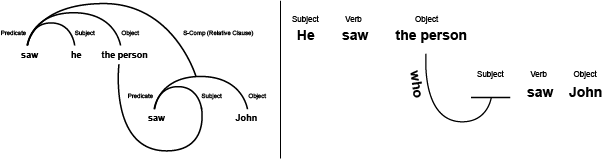
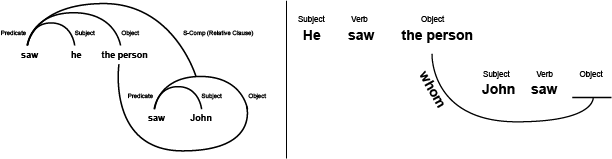
Subject & Object Relative Clauses
Kryptonian marks that same distinction explicitly, with a particle, rather than leaning on word order the way English does: /zw/ for a subject relative clause, /to/ for an object relative clause. Inside the relative clause itself, the verb stays fully finite (it carries its own TAM suffix exactly like a main-clause verb), and a direct object or complement inside the relative clause is marked with /ahm/ rather than the main clause’s /w/, specifically to avoid ambiguity between what belongs to the relative clause and what belongs to the sentence around it.
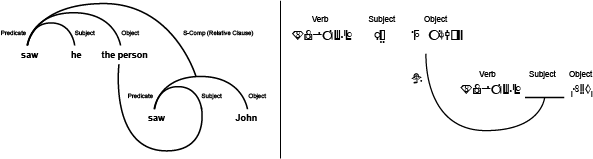
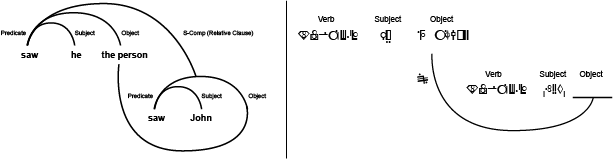
A couple more, in the vocabulary already used elsewhere on this page:
A more complex example, stacking two relative-clause-style arguments in a single sentence — a subject clause whose own subject carries a possessive:
Possessive Relative Clauses
Relative clauses can embed a full possessive structure — alienable (fused determiner), inalienable (/possessor i possessed/), or familial — right after the relative marker. The possessor becomes the subject or object of the relative clause itself:
And one more, chaining a possessive relative clause with a second one layered inside it:
Verb Adoption
When a relative clause’s verb is identical to the main clause’s — same lemma, same TAM suffix — it can simply be left out. The relative clause “adopts” the main clause’s verb instead of repeating it:
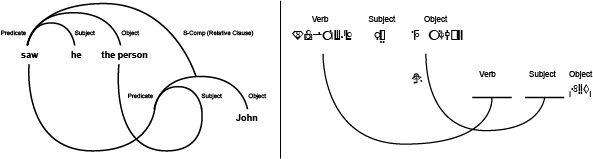
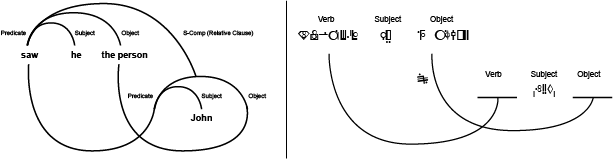
Compare each of these to its fully-spelled-out counterpart under Subject & Object Relative Clauses, above — same meaning, same particle, just without the repeated verb. If the lemma or the TAM suffix would differ between the two clauses, adoption isn’t available and both verbs are spelled out in full, as in the possessive example above.
Marking Objects Inside the Relative Clause
A relative clause can have its own object or complement, just like a main clause — and it needs its own way to introduce one, since the main clause’s /w/ is already doing its own job elsewhere in the sentence. That’s what /ahm/ ∑ is for: it plays the same role inside a relative clause that /w/ plays in a main clause, glossed R.OBJ above.
Both examples that use it, under Possessive Relative Clauses, embed a possessive chain: in “the man whose friend saw me saw you,” /ahm/ marks /khuhp/ (“me”) as the object of “saw” inside the relative clause; in “I saw the man whose name is John,” it marks /,jahn,/ (“John”) as the complement of the equative embedded inside the relative clause.
Gloss Abbreviation List
- 1: first person
- 2: second person
- 3: third person
- ABL: ablative
- ABS: absolutive
- ADJ: adjective
- ADV: adverb(ial)
- AL: alienable
- AN: animal
- ART: article
- BEN: benefactive
- CAUS: causative
- CMPR: comparative "more" (-io)
- COM: complement
- COND: conditional
- COP: copula
- DEF: definite
- DET: determiner
- F: feminine
- FUT: future
- GEN: genitive
- HAB: habitual
- HON: honorific
- IMP: imperative
- INF: infinitive
- INS: instrumental
- INTENS: intensifier/augmentative (zhi(u)-)
- LEAST: relative adjective "least" (-ie)
- LESS: relative adjective "less" (-iah)
- M: masculine
- N: neuter
- N-: non- (e.g. NSG nonsingular, NPST nonpast)
- NAL: inalienable
- NAN: inanimate
- NEG: negation/not
- NMLZ: nominalizer
- OBJ2: indirect object
- OBLIG: obligatory
- ORD: ordinal
- PASS: passive
- PER: personal
- PL: plural
- POSS: possessive
- POT: potential
- PRF: perfect
- PRS: present
- PROG: progressive
- PROH: prohibitive
- PST: past
- PTCP: participle
- Q: question
- RC.COM: relative-clause complement (marks the complement of a relative clause)
- RC.OBJ2: relative-clause indirect object (marks the indirect object of a relative clause)
- RCO: relative-clause object (head noun is the object of the relative clause)
- RCS: relative-clause subject (head noun is the subject of the relative clause)
- RECP: reciprocal
- REFL: reflexive
- REL: relative
- SBJV: subjunctive
- SG: singular
- SUPER: relative adjective (superlative) "most" (-iu)
- VOC: vocative