

Colors
Describing a continuous phenomenon like light with discrete words always requires a little flexibility. At what point on the spectrum does a color stop being yellow and start being green? Different speakers will draw that line in different places. The figure below lays out the basic Kryptonian color words against the visible spectrum they cover.
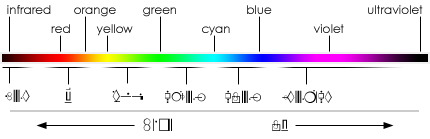
Kryptonian physiology detects a broader range of the electromagnetic spectrum than human vision does, and the effects of yellow solar radiation extend that range even further — to the point of producing the “X-Ray Vision” effect. “Heat Vision” is thought to be closely related to this same heightened visual acuity. Both abilities have been the subject of considerable speculation, but the underlying mechanisms have never been rigorously studied and remain poorly understood.
Nuances of Color
Kryptonian has two color-shifting prefixes: /gad-/ gAd moves a color toward the red end of the spectrum, while /kur-/ kü moves a color toward the violet end. So, for example, English “yellow-green” is simply /riz/ riz in Kryptonian, while English “yellow” is gAdriz — /riz/ shifted red-ward. As you’d expect, this gets fuzzy at the boundaries: at what point does küâ (“orange” — /iahr/ â, “red,” shifted violet-ward) become gAdriz (“yellow”)?
When /kur-/ combines with a stem that itself begins with /r/, only one /r/ survives: /kur-/ + /riz/ contracts to küiz, not the doubled kürriz.
Brown
Brown, /shaotehv/ SOtev, isn’t part of the spectrum pictured above. It doesn’t take the /gad-/ or /kur-/ shifting prefixes, but — like every other color word — it does take the brightness prefixes described below.
Black, White, and Gray

Black, /dol/ dol, and white, /krigh/ kriG, each have a prefixing form — the word minus its final consonant — that can be applied to any color to mean “bright” or “dark.” Red, /iahr/ â, becomes bright red (or pink) as kriâ, and dark red as doâ.
Rao in the Alphabet
In the ancient Kryptonian pantheon, Rao was the chief amongst the Gods, the one who kindled in Krypton’s sky the major lights of day, the sun (which bears his name, Rao) and, the two moons, Wegthor and Mithen. Yuda, a lesser deity, was the “Mistress of the Moons” and the goddess of love and marriage, but creation of the moons was still attributed to Rao.
The symbol for the vowel sound [a͡ʊ] also shares the name of Rao and is a pictograph of the sun and the two moons aligned as they were at his act of creation — a symbol of order out of chaos. This somewhat rare alignment in the Kryptonian sky (and only visible from certain latitudes) was considered a sacred sign of marriage — itself depicted as two souls aligning in order to initiate their own act of creation (procreation).
This letter shares the name of Rao and is used to depict that name, i.e., one does not write his name as ,rO, but rather with the single letter ,O, used ideographically.
Paradoxically, as the pantheon of Krypton’s earlier era evolved into the monotheistic religion of Raoism, the goddess Yuda increased in prominence in wedding ritual and imagery. This is despite the decline of the cult of Yuda and Yuda worship in general. Rather, Yuda became a prominent archaic symbol of marriage that served to symbolize a connection to the past rather than being an object of worship.
It should be noted that by the time of Krypton’s destruction, almost all wedding imagery omitted the sun entirely leaving only the two moons — the letter O, though, depicts the older, three-body symbol. This migration from the triple to the double alignment almost certainly was fueled by the fact that the lunar alignment alone (without Rao) was far more common in both frequency and observability, dramatically increasing the opportunities for the auspicious timing of weddings.
Etymology of /zrhynj/
A surprising amount of Kryptonian’s core vocabulary — words for animal husbandry, writing, family structure, computers, even the name of Krypton’s capital — traces back to a single root: /zrhynj/ ZRynj, originally an onomatopoeia for the ring of metal being forged. Over time its meaning loosened from “forging” specifically to “making” in general, and from there it became one of the most productive roots in the language.
/zrhynj/ combined with the verbalizer suffix /-iv/ to produce /zrhyv/ ZRyv, “to work” — literally “to do-make,” a small redundancy that nonetheless shifted the word’s emphasis away from the object of creation and onto the act of doing. Where /zrhynj/ connotes creation or forging, /zrhyv/ connotes effort and labor.
Domesticated Life and Academia
- /zrhyv/ + /khaoghao/ (“animal”) → /zrhykhaog/ ZRyhOg, literally “work animal,” which broadened over time to mean any domesticated animal.
- /imokh/ (“to train” — think doctoral student, not athlete) gave rise to a cluster of academic vocabulary once combined
with /zrhyv/:
- /zrhyv/ + /imokh/ → /zrhymokh/ ZRymoh, “to do the work of training” — i.e., to write.
- /zrhymokh/ + the nominalizer /-ehd/ → /zrhymokhehd/ ZRymohed, “the thing produced by writing” — composition, essay.
Houses, Kin, and Sacred Machines
- /zrhynj/ + /threv/ (“name”) → /zrhythrev/ ZRyTrEv, “created name” — the clans who “forged their
name” and rose out of Krypton’s tribal era to become the great houses of the golden age.
- /zrhythrev/ + the person suffix /-ium/ → /zrhythrevium/ ZRyTrEvúm, “person of a house.”
- /,rao,/ ,O,, the name of Krypton’s god, combined with /zrhynj/ to give /raozrhynj/ rOZRynj, “god-creation” or “god-forged” — a made thing (usually of metal) that can think. Picture Krypton’s advanced computer systems and artificial intelligences, not the machine on your desk. It’s the everyday word for a computer.
- /lish/ (“to count”) + /zrhynj/ → /zrhysh/ ZRyS, “number” — the things created in the act of counting.
- /ahmin/ was the ancient Kryptonian word for “family.” The word itself was lost when the rise of the houses gave Kryptonian /zrhythrev/ instead, but it survives baked into other words:
- /zrhynj/ + /ahmin/ → /zrhymin/ ZRymin, “spouse” — literally “created family”: not something you were born into, but something you made. It later acquired vowel gendering.
- /zrhymin/ then back-formed into /-min/ a suffix meaning “in-law,” seen in words like /unahmin/ (“son-in-law”) or /odhozmin/ (“uncle-in-law” — technically your father’s brother by marriage).
Cities: From Plan to Kryptonopolis
The etymology behind Kryptonian’s word for “city” is a little more convoluted. It starts with /regrhahs/ rEGRas, “plan.” Adding the now-archaic augmentative prefix /u-/ produced /ugrhahs/ uGRas, something like “great plan” — first used during the transition out of tribalism to describe what would eventually become Krypton’s great cities.
That, in turn, combined with /zrhyv/ to form /zrhygrhahs/ ZRyGRas, “the work of a great plan.” The compound /-ygrhahs/ was later back-formed into a standalone suffix meaning “city,” giving us the now-famous /,kryptahnygrhahs,/ ,kryptanyGRas,, which Superman cleverly — and accurately — translated into English as “Kryptonopolis.”
The same root also gave rise to Kryptonian’s word for sin. /udol/ (“evil”) combined with /zrhyv/ and /ugrhahs/ to form /udolzrhygahs/ udolZRygas, something like “the great plan of evil” It likely entered use around the same time as /zrhygrhahs/, originally describing rival cities or enemy strongholds, before drifting into the more polemical sense of “sin” or “transgression” — the evil inner state or motives of the people of that rival city. For a precision-minded, order-valuing culture, sin is planned disorder. It’s not a mistake; it’s a deliberate alignment with entropy and chaos.